
The Word ‘Mantle’ In Scripture
The word ‘mantle’ evokes thoughts of a fireplace and the small wood shelf above it on the chimney. But biblically, the word has a much more substantial meaning. The Bible (KJV) has 13 total mentions of the word ‘mantle,’ with 3 slightly different definitions according to the context in the text and the word’s Hebrew root.
For example, in Judges 4:18, the Hebrew word used for ‘mantle’ is ‘semiykah’ (sem-ee-kaw), meaning ‘a rug,’ or what we would today call a blanket. This is the first time the word ‘mantle’ is used in the Bible, and it is the only use of this version of the word, with the Hebrew root of ‘semiykah,’ in both the Old and New Testaments.
The next 7 verses that use the word ‘mantle’ have an origin in the Hebrew word ‘meiyl’ (meh-heel), which means ‘covering; a robe (upper outer garment); cloak, coat’. The 7 verses with this use can be found in: 1 Samuel 15:27; 1 Samuel 28:14; Ezra 9:3; Ezra 9:5; Job 1:20; Job 2:12; Psalms 109:29.
The remaining 5 verses that use the word ‘mantle’ in the Bible have an origin in the Hebrew word ‘addereth’ (ad-deh-reth), meaning ‘something ample (as large vine, a wide dress); a garment; glory; goodly; robe.’ Here are the final 5 verses in which this version of the word ‘mantle’ is used: 1 Kings 19:13; 1 Kings 19:19; 2 Kings 2:8; 2 Kings 2:13; 2 Kings 2:14.
What A ‘Mantle’ Is (And What It Can Represent)
From this brief study, we find that a ‘mantle,’ biblically, is a literal physical garment (a robe, a skirt, a garment with no sleeves that wrapped around the shoulders like a shawl but longer, a coat, a cloak, a blanket that’s worn for warmth, etc). But it also has a meaning of a covering, of glory, and when we read all 13 verses, we find that it actually has greater significance in the wearer’s identity.
Clothing, Identity, And Authority In The Bible
The clothing worn in the Bible carried meaning. Identity and authority could be identified by the apparel worn, physical garments being a symbol of the life and calling of the wearer. For example, priests were to wear an ephod, robes, tunics, a belt, a crown, and linen pants. Kings and royalty wore fine robes of purple, generally. Wealthy individuals wore fine linen and other expensive, more luxurious materials at the time, like wool.
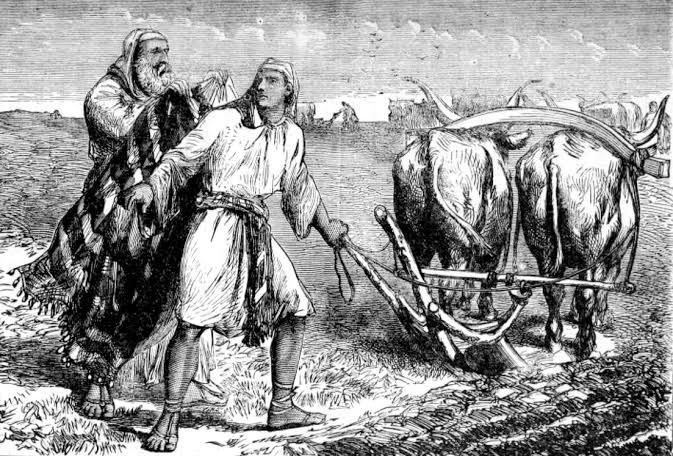
Certain prophets — Elijah and Elisha — are explicitly associated with the ‘mantle’. A ‘mantle’ can be described as a heavy, rough outer cloak, usually made in a rectangular shape with no sleeves, worn over the shoulders, and sometimes fastened with a belt around the waist. It was earth toned, made from coarse materials like camel hair, goat hair, or sheep’s wool. It was uncomfortable, weather resistant, and had practical use in the wilderness. Occasionally used as bedding, it was a garment of function—unadorned—and worn by some prophets as a marker or identifier that the wearer was called and commissioned by God, and had God-given authority in the office God had spiritually empowered them to operate in.
The ‘mantle’ itself had no authority, but it functioned as an outward sign of an inward calling.
See the verse list below to learn more about the characteristics of the ‘mantle’ in the Bible.
The ‘Mantle’ As A Symbolic Act And Instrument
Garments worn in the Bible had great symbolic significance. When Elijah cast his ‘mantle’ upon Elisha in 1 Kings 19:19, it was a symbolic act with the literal garment that identified Elisha as Elijah’s successor.
When Elijah, and then later Elisha, used the ‘mantle’ in 2 Kings 2:8 to strike the waters, the waters parted. The ‘mantle’ here was likened to Moses’ staff, and was an object of a miracle that God performed twice with that same garment in 2 Kings 2:14.
Torn Garments And Their Meaning
When a garment is torn in the Bible, it too has a greater meaning according to the context. For example, many people in the Bible are said to have torn their garments and put dust on their head. This was a show of grief, of great inner turmoil, and even repentance.
We see this happen to Ezra in Ezra 9:3-5, when he tears his ‘mantle’ off out of anguish over the spiritual state of Israel. Job does this after the Devil destroys his life and he is in utter sorrow, cursing the day he was born. See the list down below to study every instance where a garment was rent by someone in this same manner.
Other times a garment being torn has significance in the Bible include when Saul rent Samuel’s ‘mantle’ in 1 Samuel 15:27. Saul told Samuel that God had cut down his kingdom. The tearing of the garment here was a symbolic act of the spiritual happenings; Samuel’s authority as king was being stripped away by God.
David cut Saul’s skirt in 1 Samuel 24:4 to show his loyalty and prove his good intentions. Saul was paranoid that David would take his place because David was anointed as a child by God to someday be king. David proved that he could kill Saul when he boldly cut his skirt without Saul knowing, but then delivered the piece to Saul humbly.
See the verse list below for all verses related to ‘garments’ in the Bible.
Putting It All Together
So let’s put this all together. Biblically, a ‘mantle’ is a literal physical garment worn by some prophets as a visible sign of separation, humility, and divine assignment. The power is not in the cloth; rather, it marked who God had called and sent.
The word ‘mantle’ is used to describe other garments worn throughout the Bible, and the meaning slightly differs based on the context and Hebrew origin. This is why it is important to discern the usage of the word ‘mantle’ to understand the depth of the verse it’s being used in.
Historical English Usage (Webster 1828)
The Bible itself offers a great view of the significance of the word ‘mantle’ and how its definition slightly differs based on the context and its Hebrew origin. Still, it’s important to go deeper into the word and its meaning.
The word ‘mantle’ in the Noah Webster’s 1828 dictionary has 9 different definitions: as a noun, it is a kind of cloak or loose garment to be worn over other garments; a cover, that which conceals. As a transitive verb: to cloak, to cover, to disguise; to expand, to spread; to joy, to revel; to be expanded, to be spread or extended; to gather over and form a cover, to collect on the surface, as a covering; to rush to the face and cover it with a crimson color, as in to blush.
The mantle we all think of — the piece of timber or stone in front of the chimney above the fireplace — originates from the word ‘mantle-tree’ or ‘mantle-piece’ .
Each Verse Where ‘Mantle’ Is Used In The Bible
Judges 4:18 – “And Jael went out to meet Sisera, and said unto him, Turn in, My lord, turn into me; fear not. And when he turned in unto her into the tent, she covered him with a mantle.” The Hebrew word for ‘mantle’ being used here is ‘semiykah’ (sem-ee-kaw), meaning ‘a rug,’ or what we would today call a blanket. This verse is simply talking about a woman covering a man with a blanket after he experienced chaos.
1 Samuel 15:27 – “And as Samuel turned about to go away, he laid hold upon the skirt of his mantle, and it rent.” The Hebrew word for ‘mantle’ being used here is ‘meiyl’ (meh-heel), which means ‘covering; a robe (upper outer garment); cloak, coat’. This verse is showing how a king’s authority is cut down by God.
1 Samuel 28:14 – “And he said unto her, What form is he of? And she said, An old man cometh up, and he is covered with a mantle. And Saul perceived that it was Samuel, and he stopped with his face to the ground, and bowed himself.” The Hebrew word for ‘mantle’ being used here is ‘meiyl’ (meh-heel), which means ‘covering; a robe (upper outer garment); cloak, coat’. Here we see that it is Samuel’s garment (mantle) that is used as an identifier for who he is and his God-given authority.
1 Kings 19:13 – “And it was so, when Elijah heard it, that he wrapped his face in his mantle, and went out, and stood in the entering of the cave. And, behold, there came a voice unto him, and said, What dost thou hear Elijah?” The Hebrew word for ‘mantle’ being used here is ‘addereth’ (ad-deh-reth), meaning ‘something ample (as large vine, a wide dress); a garment; glory; goodly; robe.’ Elijah covers his face with his ‘mantle’ and hears the still small voice of God. The usage of the word here could be showing us that God is covering and protecting Elijah, and the ‘mantle’ could be a physical symbol of this spiritual covering and God’s glory. Note that one of the definitions for the Hebrew word ‘addereth’ is glory.
1 Kings 19:19 – “So, he departed thence, and found Elisha the son of Shaphat, who was plowing with twelve yoke of oxen before him, and he said with the twelfth: and Elijah passed by him, and cast his mantleupon him.” The Hebrew word for ‘mantle’ being used here is ‘addereth’ (ad-deh-reth), meaning ‘something ample (as large vine, a wide dress); a garment; glory; goodly; robe.’ Here we are seeing a transfer of identity and responsibility. Elijah casts his ‘mantle’ upon Elisha to designate him as his successor. The ‘mantle’ here represents a calling, authority, and spiritual empowerment given by God. But it is not an immediate role that Elisha steps into. Rather, this ‘mantle’ cast upon him was a symbol of the calling upon his life, but the authority would come later, after Elijah was taken up to heaven. First, Elisha had to follow Elijah and learn and serve. Then he picks up the ‘mantle,’ literally and symbolically, and carries on the mission he was assigned to by God.
2 Kings 2:8 – “And Elijah took his mantle, and wrapped it together, and smote the waters, they were divided hither and thither. So that they two went over on dry ground.” The Hebrew word for ‘mantle’ being used here is ‘addereth’ (ad-deh-reth), meaning ‘something ample (as large vine, a wide dress); a garment; glory; goodly; robe.’ God uses Elijah and his ‘mantle’ to perform a miracle. The narrative presents a physical expression of an underlying spiritual reality. The power isn’t in the garment, nor is it Elijah’s power. Rather, God functions as the source of power, Elijah as the agent, and the mantle as the instrument through which the action is enacted.
2 Kings 2:13-14 – “He took up also the mantleof Elijah that fell from him, and went back, and stood by the bank of Jordan; and he took the mantleof Elijah that fell from him, and smote the waters, and said, Where is the LORD God of Elijah? And when he also had smitten the waters, they parted hither and thither, and Elisha went over.” The Hebrew word for ‘mantle’ being used here is ‘addereth’ (ad-deh-reth), meaning ‘something ample (as large vine, a wide dress); a garment; glory; goodly; robe.’ This verse is showing us a completion of the transfer of authority and identity from Elijah to Elisha. Elijah is taken up to heaven, and Elisha tears his own clothes. He is rightfully grieving the loss of his friend and mentor. However, he picks up the physical mantle that Elijah left behind, and he calls on the God of Elijah. He strikes the waters with the ‘mantle,’ and again they part. The transference of authority—and the completion of this transference—is shown once Elisha walks on dry land through parted waters.
Ezra 9:3-5 – “And when I heard this thing, I rent my garment and my mantle, and plucked off the hair of my head and of my beard, and sat down astonied. Then were assembled unto me every one that trembled at the words of the God of Israel, because of the transgression of those that had been carried away; and I sat astonied until the evening sacrifice. And at the evening sacrifice I arose up from my heaviness; and having rent my garment and my mantle, I fell upon my knees, and spread out my hands uno the LORD my God…” The Hebrew word for ‘mantle’ being used here is ‘meiyl’ (meh-heel), which means ‘covering; a robe (upper outer garment); cloak, coat’. Ezra tears his ‘mantle’ off. While he was not a prophet, he wore the ‘mantle’ of a scribe-priest. He tears his clothes because he is in such grief and sorrow over the spiritual state of Israel. See that exhaustive list of verses above to do a deeper dive on clothes being ‘rent’ in the Bible.
Job 1:20 – “Then Job arose, and rent his mantle, and shaved his head, and fell down upon the ground, and worshipped.” The Hebrew word for ‘mantle’ being used here is ‘meiyl’ (meh-heel), which means ‘covering; a robe (upper outer garment); cloak, coat’. Job tears his clothes because of the sorrow and grief he was experiencing after the Devil destroyed his life. The meaning here is the same as in Ezra 9:3-5.
Job 2:12 – “And when they lifted their eyes afar off, and knew him not, they lifted up their voice, and wept; and they rent everyone his mantle, and sprinkled dust upon their heads toward heaven.” The Hebrew word for ‘mantle’ being used here is ‘meiyl’ (meh-heel), which means ‘covering; a robe (upper outer garment); cloak, coat’. Job’s friends join him in his grieving. While they are doing it sympathetically, the meaning is the same as in Job 1:20 and Ezra 9:3-5.
Psalms 109:29 – “Let mine adversaries be clothed with shame, and let them cover themselves with their own confusion, as with a mantle.” The Hebrew word for ‘mantle’ being used here is ‘meiyl’ (meh-heel), which means ‘covering; a robe (upper outer garment); cloak, coat’. This verse is a call for adversaries to be clothed in shame and confusion. If their ‘mantle’ is confusion, then their office, authority, responsibility, and even identity is confusion.
Conclusion
We have defined the word ‘mantle’ biblically, historically, and symbolically. We have observed its practical uses and its spiritual applications. We addressed every Bible verse that utilizes the word ‘mantle,’ and we’ve discussed the 3 different Hebrew words that the word ‘mantle’ originates from, and how the meanings slightly differ based on the context and Hebrew root.
What we’ve learned, putting it altogether, is: a ‘mantle’ biblically refers to a literal physical outer garment worn by some prophets to protect from weather and identify the wearer as a prophet. The ‘mantle’ was worn to signify the God-given identity, authority, and calling or divine commission of the wearer. The process follows that God calls someone, symbolically lays the ‘mantle’ upon them to mark them for their purpose, and then he assigns the individual.
We saw how the ‘mantle’ is also used to describe God’s glory and covering over Elijah when he hears the still small voice. When torn, it could symbolize God’s cutting down of the authority of the wearer and/or the active sorrow and grieving of the wearer. Scripture does not teach that a literal or invisible ‘mantle’ imparts power. Rather, the ‘mantle’ is a biblical symbol used to illustrate God’s sovereign calling and succession.
Verse Lists For Further Study
‘Mantles’
Judges 4:18; 1 Samuel 15:27; 1 Samuel 28:14; 1 Kings 19:13; 1 Kings 19:19; 2 Kings 2:8; 2 Kings 2:13; 2 Kings 2:14; Ezra 9:3; Ezra 9:5; Job 1:20; Job 2:12; Psalms 109:29.
Characteristics of ‘mantles’
2 Kings 1:8; Zechariah 13:4; Matthew 3:4; Mark 1:6.
Clothes being ‘rent’
Jacob in Genesis 37:34; Joshua and Caleb in Numbers 14:6; Joshua in Joshua 7:6; Jepthah in Judges 11:35; the messenger in 1 Samuel 4:12; the messenger in 2 Samuel 1:2; David in 2 Samuel 1:11-12; Tamar in 2 Samuel 13:19; the king and his servants in 2 Samuel 13:31; Hushai the Archite in 2 Samuel 15:32; Ahijah in 1 Kings 11:30; Ahab in 1 Kings 21:27; Elisha in 2 Kings 2:12; the king in 2 Kings 5:7; 2 Kings 6:30; Athaliah in 2 Kings 11:14; 2 Kings 18:37; Hezekiah in 2 Kings 19:1; the king in 2 Kings 22:11; Athaliah in 2 Chronicles 23:13; the king in 2 Chronicles 34:19; Ezra in Ezra 9:3-5; Mordecai in Esther 4:1; Job in Job 1:20; Job’s friends in Job 2:12; Isaiah 36:22; Hezekiah in Isaiah 37:1; a group of 80 men in Jeremiah 41:5; the high priest in Matthew 26:65; the high priest in Mark 14:63; the apostles in Acts 14:14; the magistrates in Acts 16:22.
Other related verses on ‘garments’
Genesis 9:23; Genesis 25:25; Genesis 39:12-18; Exodus 22:26-27; Leviticus 6:10; Leviticus 6:27; Leviticus 13:47-59; Leviticus 14:55; Leviticus 15:17; Leviticus 19:19; Deuteronomy 22:5; Deuteronomy 22:11; Joshua 7:21; Joshua 7:24; Judges 8:25; Ruth 3:9; 2 Samuel 13:18-19; 2 Samuel 20:8; 1 Kings 11:29-30; 2 Kings 9:13; Esther 8:15; Job 13:28; Job 30:18; Job 38:9; Job 38:14; Job 41:13; Psalms 69:11; Psalms 73:6; Psalms 102:26; Psalms 104:2; Psalms 104:6; Psalms 109:18-19; Proverbs 20:16; Proverbs 25:20; Proverbs 27:13; Proverbs 30:4; Isaiah 50:9; Isaiah 51:6-8; Isaiah 61:3; Jeremiah 43:12; Ezekiel 18:7; Ezekiel 18:16; Daniel 7:9; Micah 2:8; Haggai 2:12; Malachi 2:16; Matthew 9:16; Matthew 9:20-21; Matthew 14:36; Matthew 22:11-12; Mark 2:21; Mark 5:27; Mark 6:56; Mark 10:50; Mark 13:16; Mark 16:5; Luke 5:36; Luke 8:44; Luke 22:36; Acts 12:8; Hebrews 1:11; Jude 1:23; Revelation 1:13.


Leave a comment