
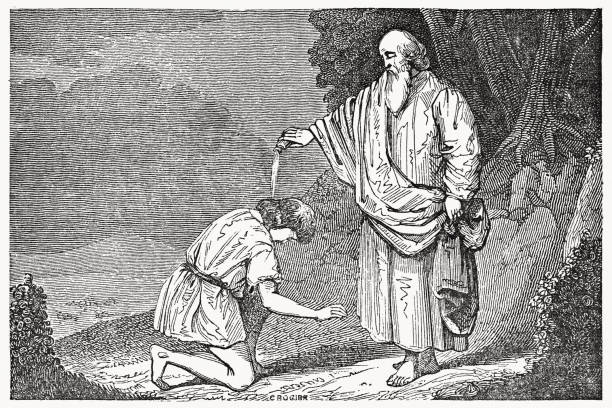
God doesn’t call the qualified, He qualifies the Called. Did you know that every figure in the Bible (apart from Jesus who in Him was found to have no iniquity whatsoever and perhaps Job who God called “perfect”) was flawed and a sinner? Because they were human just like us, they were not immune to messing up. This is encouraging to us Christians today because many of us feel inferior, incapable, condemned and or conflicted. Many of us even feel like we’re hypocrites because we know the truth, we speak the truth, but we just don’t always live out and do the truth. But God wants us to know that nothing is too hard for Him and we are not called by Him because we are perfect like Jesus or Job. But we are called for the very same reason that he chose 12 sinners to be His Disciples. He useS the foolish things to confound the wise. He chooses the least likely choice for every situation and He does this to prove a point: I Am God.
Jacob was a cheater, Peter had a temper, David committed adultery, Noah got drunk, Jonah ran away from God, Paul murdered and persecuted Christians, Gideon had insecurity and low self esteem, Miriam was gossiper, Martha was a worrier, Thomas was a doubter, Sarah was impatient, Elijah and Jeremiah were depressed, Moses was a stutterer, Zacchaeus was short, Abraham was old (and David “too” young), and Lazarus was dead. These people were called by God and qualified by Him, used in spectacular ways to advance His perfect will. Jacob didn’t remain a cheater, Paul didn’t remain a murder, Thomas didn’t remain a doubter, and Lazarus did not remain dead. All of these figures and others in the Bible went through something that caused them to change. God called these people when they were worriers and gossipers and doubters. But the things they went through and the transformations made in them were their qualification processes which allowed God to utilize them as He desired.
Jacob had to labor for years under Laman to learn what it was like to be on the other side of a dishonest man. The crow of a rooster opened Peter’s eyes and he had to watch his Savior be crucified after he had denied Him. David had to choose from a list of three terrible judgements for his affair and murder. He lost the baby that was conceived during the affair and he faced a physical ailment (probably some sort of STD) for the rest of his life. Noah did not become an alcoholic as it seemed that he learned from his mistake. He was probably one of the only other ones in the Bible who was referred to as “ perfect” so his story from this perspective is more of one of a man who was perfect who made a mistake and learned from that mistake. But his mistake is proof that God is not looking at the hands of man and what they are doing with them, but at their hearts and what is inside of them. Jonah had to spend three days in the belly of a whale to learn that one could not run from God, especially not without consequences. When God intends to do something, He will do it. Jonah’s story shows us that we are not powerful enough to derail or destroy God’s plans. His will will be done and he can use our mistakes to work within His will.
Paul faced persecution and even died by stoning but was raised back up according to God’s will. The persecution he faced taught him much about the persecution Jesus faced and as a result God used him to deliver the message of grace for us today. Gideon had to face a large mass of men in battle with only 300 soldiers because his insecurity in their numbers offended God. This adversity was orchestrated by God to prove the strength and omnipotence (unlimited power) of God and as a result Gideon’s faith was reinforced and his insecurity was restored with confidence in the LORD. Miriam faced leprosy on her whole body as a result of her gossip of Moses and was forced to spend seven days outside the camp. Due to this disease she never speaks nor is spoken to again (a fitting punishment for a gossiper) and she is no longer mentioned until her death. The message is very clear about the consequences of sin and the Bible is clear that God will deal with us the way we deal with others. But because we are under grace we need to also understand that God forgives us and we can repent (change our minds) and turn from our wrong ways to be restored to our former glory and realign ourselves with His will. Unfortunately for Miriam, she was under a different dispensation and did not have the grace that we have today. Though, because of the intercession of Aaron and the appeal to God that Moses makes, God does not let Miriam die of the disease. Jesus made it clear to Martha that worrying over little things excessively was actually a sin and she wasn’t utilizing her brain space for the right things. She should’ve been more concerned with learning from Jesus, but instead, she was frantically focused on cooking and her duties in the kitchen. Jesus’ words offered insight and clarity into her worries, allowing her eyes to open to what was truly important. Thomas’ doubt was shed when he beheld and touched the holes in the hands of Jesus after He had risen to life after three days in the grave following His Crucifixion. Jesus blesses those who believe without needing to see and this is a valuable event to read about as it offers insight into the kind of faith that God expects from us. The Bible tells us that without faith it is impossible to please God.
Abraham and Sarah were both too old to conceive, but Abraham faithfully believed God’s promise that a nation numbering the stars would be born from him and he waited on God with trust and endurance. Sarah’s impatience however caused them to make a poor decision that would later lead to the origins of the descendants of Israel’s enemies and the terrorism we know and see today. Israel would come from Abraham’s seed and Sarah’s womb, but Israel’s enemies would come from Abraham’s seed and Sarah’s servant Hagar’s womb. Even though she was impatient and acted on her own accord to try and rush along God’s promise, God was still able to work out His will and accomplish His goals through them. Elijah was worn out by the Israelites because they did not keep God’s covenant and he wanted to die because he was being murderously pursued by Queen Jezebel. While he was a faithful prophetic voice to the children of Israel, God took him before he could ever taste death. While on Earth in his depression hiding away in the wilderness, God sent an angel to look after and encourage him because he had been zealous for God and theLaw and was a faithful prophet to the people. Jeremiah also faced depression because the children of Israel refused to hearken to his warning words of the coming judgment of God. He felt ineffective because no one heard him and would repent. He was lonely with no wife or kids of his own and he endured the trauma of the bloody Babylonian destruction of the city of Jerusalem and the Temple. God was faithful to keep Jeremiah safe through these events and He was Jeremiah’s company and comfort throughout his life. Neither Elijah’s nor Jeremiah’s depression prohibited them from doing their duty and fulfilling their purposes. And God dealt with their depression by putting them to work and providing them with purpose, but He was always constant and there to comfort.
Moses was a stutterer and argued with God about doing what God asked of him. But God offered aid to Moses in the form of his brother Aaron who spoke for Moses. Despite Moses’ physical impediments God was able to use him as God’s voice and free the people from slavery in Egypt. It’s worth noting that God was angry when Moses wasn’t willing to go to Pharaoh on his own. God was angry because, just like with Gideon, He wanted His glory to show through. He wanted to use someone who appeared incapable to prove that He was the power behind the success of that person. In other words, He wanted to perform a miracle. Zacchaeus, who was short, wanted to see Jesus in person when He spoke. But because he was short he could not see over the crowd. For this reason, he chose to climb a tree to see Jesus when he knew that He was coming and later Jesus came to his home to fellowship with him. Sometimes we feel insignificant or like our immutable (unchangeable) characteristics limit us. But God notices us and He created us exactly as He intended for us to be. Zacchaeus climbing the tree proved the desire in his heart for Jesus and Jesus took note of this. It is again what is within us that God sees and not what is outside us. Lazarus was dead. There was nothing that man could do to save himself. But when Jesus called his name and commanded him to “come forth”, he awoke from his slumber in death and was alive again. You could be dead and God could still use you. Nothing can separate us from the Love of God and the purpose He has for us, not any man, not the Devil, not even our own mistakes, not even death.
God looks at the heart of man, not at the hands of man. Yes, what we do matters. But what we do on the outside is actually usually a result of who we truly are on the inside which is what God is concerned with most. However, it is important to note that there are those who act oppositely or deceitfully from who they truly are on the inside and what they truly believe. These people are dangerous and the Bible calls them “wolves in sheeps clothing”. It is so important that we do not allow ourselves to become “sheeps in wolves clothing” either. Because we are Christians and we know what we ought to do, if we go on to do the things of the world that are opposed to God’s word and command then we are also acting deceitfully from what we believe (or else we should examine how strong our convictions were in the first place). Some do this to “fit in” or to receive some sort of honor and esteem from man. But this is in direct contradiction with what God tells us to do which is to run in the opposite direction of the world, to not fellowship with evil (or those who may cause us to sin or affect our reputation with their behavior and words), and to stay on the righteous path which is narrow and many do not find it.
So, what is the qualification process of those called by God? It is a sinner like you and me that goes through storms in order to identify sin, get stronger, and grow, resulting in a radical change that allows God to use them for His perfect will.
What we have to walk away from here with is the understanding that all things are in God’s hands and in His control. No person or force is powerful enough to countermand or challenge God’s will. If we refuse, because He’s given us free will and will not force anything upon us, He will leave us to our own devices and find someone else to do His work. God can, will, and has replaced people when they did not do what He asked of them. Consider the first King of Israel, Saul. He sinned against God and God replaced him with David. This is an important warning to heed. If we understand that our behavior and the standing of our hearts has much weight in where we end up in this world, then it should deter us from following the world. But even if we do go our own way, our God is a merciful, good God. He is the good shepherd that leaves the ninety-nine to find and save the one. Let us stop condemning ourselves and wrongfully believing that we and our mistakes are powerful enough to ruin God’s plan for us in our lives. The reality is that God works all things for good and He turns our pain into purpose. Our God is more powerful than our mistakes and He can and will use them for good. These mistakes we make and these storms we face are all a part of the qualification process that God is doing in our lives for the benefit of us and others.
Helpful verses for understanding this article fully:
Jacob’s story – Genesis chapters 25-50
Peter’s story – Matthew 4:18-20; Matthew 8:14-15; Matthew 10:1-2; Matthew 14:22-33; Matthew 16:13-23; Matthew 17:1-13; Matthew 26:30-75; Mark: 8:27-38; Mark 9:2-13; Mark 13:3-13; Mark 14:26-42; Mark 14:53-72; Luke 5:1-11; Luke 6:12-16; Luke 9:28-36; Luke 22:7-13; Luke 22:31-34; Luke 22:54-62; Luke 24:1-12; John 13:1-38; John 18:10-11; John 18:15-18; John 18: 25-27; John 20:1-10; John 21:1-25; Acts 1:12-26; Acts chapters 2-3; Acts 4:1-22; Acts chapter 5; Acts 8:9-25; Acts 9:32-43; Acts chapter 10-12; Acts 15:1-21; *1 & 2 Peter are the Books of The Bible that Peter authored but are not directly about his life.
David’s story – Ruth 4:18-22; 1 Samuel 16-the rest of the Book of Samuel; all of 2 Samuel; the 1 & 2 Books of Kings; 1 Chronicles 1-29:26; *The Book of Psalms is mostly written by David and is a collection of songs and poems that he wrote about what he was facing and about and to God.
Noah’s story – Genesis chapters 5-9
Jonah’s story – The Book of Jonah
Paul’s story – Acts 7:54-28:31; *The Books of Romans, Ephesians, 1 Thessalonians, Philemon, 2 Corinthians, Philippians, 2 Timothy, Hebrews, Galatians, Colossians, Titus, as well as some of Acts were all authored by Paul.
Gideon’s story – Judges 6:11-8:35
Miriam’s story – Exodus 15:20-21; Numbers chapter 12; Deuteronomy 24:9; 1 Chronicles 4:17; 1 Chronicles 6:3
Martha’s story – Luke 10:38-42
Thomas’ story – Matthew 10:3; Mark 3:18; Luke 6:15; John 11:16; John 14:15-16; John 20: 24-29; John 21:2; Acts 1:13
Abraham & Sarah’s story – Genesis chapter 12-25; Acts 7:1-8; Galatians 3:1-9; Galatians 4:21-31; Romans 4:1-25; Hebrews 7:1-10
Elijah’s story – 1 Kings chapters 17-19; 1 Kings 21:17-29; 2 Kings chapters 1-2; 2 Kings 3:11; 2 Kings 9:10-11; 2 Kings 10:10; 2 Kings 10:17; 2 Chronicles 21:12; Ezra 10:21; Malachi 4:5
Jeremiah’s story – 1 Chronicles 5:24; 1 Chronicles 12:4-13; 2 Chronicles 35:25; 2 Chronicles 36:8-23; Ezra 1:1; Nehemiah 10:2; Nehemiah 12:27-43; The Book of Jeremiah; Daniel 9:2; The 1 & 2 Books of Kings, The Book of Jeremiah, and The Book of Lamentations were all authored by Jeremiah.
Moses’ story – The Books of Exodus, Leviticus, Numbers and Deuteronomy; The Books of Genesis, Exodus, Leviticus, Numbers, and Deuteronomy were all authored by Moses.
Zacchaeus’ story – Luke 19:1-10
Lazarus’ story – John 11:1-45; John 12:1-19
Job’s story – The Book of Job
 Standard Bearers
Leave a comment