
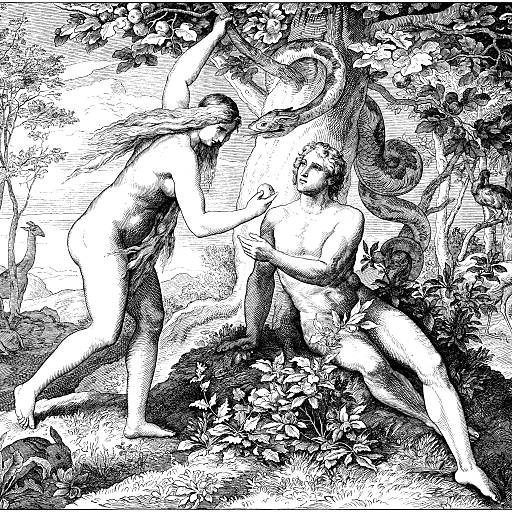
In the Garden of Eden event in the Bible when Adam and Eve ate of the forbidden fruit and fell (Genesis 3), 3 mistakes that Adam made must be highlighted. Often when discussing this event the heftier blame seems to fall on Eve’s shoulders. Even though she is at fault for what she did, it is less noted where Adam went wrong and what we can learn from his mistakes. We all know that Eve *added to God’s command about the tree, disobeyed the command because she was tempted by the Serpent, and even though she did the wrong thing by eating the fruit of the Tree of Knowledge of Good and Evil, she became a temptress herself and gave the forbidden fruit to her husband to eat. It should also be noted that Eve began speaking to a snake . . . I don’t know about you, but if my husband and I were the only humans on Earth, and suddenly a voice spoke to me that wasn’t God’s or my husband’s, and it belonged to an animal, especially a snake, I would be running! Eve made several mistakes, this is true. But Adam cannot escape the situation guiltless.
When Eve was brought to Adam, he instantly recognized her as his wife. He says, “This is now bone of my bones, and flesh of my flesh: she shall be called Woman, because she was taken out of Man. Therefore shall a man leave his father and his mother, and shall cleave unto his wife: and they shall be one flesh.” (Genesis 2:23-24) I find this personally amazing because Adam never had a mother or a traditional fleshly father. To understand leaving these key figures in any man’s life behind and now cleaving to the only human he’s ever known (and just met) is very intriguing. She was given to Adam because God saw that none of the other creations He’d made were a proper partner to Adam. The words Adam speaks upon meeting Eve are striking because they demonstrate intimacy, connectedness, and affection. It’s as if he was so grateful to finally have someone suitable for him to fellowship with. I imagine that one would become lonely even if they had a perfect Earth and an even more perfect garden to reside in. Even with all the most delicious fruits in the world and all the sweetest creatures in the world, without proper social connection, especially intimacy, one would find it hard not to become lonely. It’s recorded that in the cool of the day, God came to walk and talk with Adam and Eve (Genesis 3:8). Whether they expected Him or not, God did not hesitate to fellowship with His creation upon His will. This would suggest that while God was accessible to Adam, he wasn’t spending every waking second with God, and he seemingly spent most of his time alone on Earth without God immediately, physically at his side. That is, of course, until Eve.
Considering all of this, it is very interesting that Adam left Eve alone when the Serpent slid in to tempt her. Adam named every single animal himself, and it seems strange that he didn’t notice when one of the animals he personally named was different than it used to be. How did he not notice that the serpent had a different spirit in it? How did he not notice the way it stalked his wife, or that it suddenly had a voice to speak with? Perhaps, because he was created (not even put through the strenuous birthing or slow, painful growing process) in a perfect, flawless environment he grew passive. Passivity is a very dangerous thing and needs to be overcome, but it deserves an article of its own at a different time. Adam made multiple mistakes, just as Eve did. But here, we are going to focus on 3 specific mistakes Adam made that fateful day when man fell.
- Adam was not by his wife’s side. We know this because had Adam heard the other voice in the garden, or had he witnessed Eve eating the fruit, he most certainly would’ve stepped in to stop her. He had to be out of earshot and or distracted by something else.
Here we can learn the importance of not becoming passive, too comfortable, lazy, or unproductive. There are many warnings in the Bible about paying attention, standing watch, being observant, and being sober (one does not have to be physically intoxicated to not have a sober mind). Had Adam been near his wife, paying attention, and keeping watch (for anything), he very well could have prevented his wife from striking up a conversation with a dangerous stranger. The first mistake Adam made has to do with prevention.
- Adam did not consult God on what to do. After Adam learned that his wife had eaten the forbidden fruit, he chose to follow her and eat too. He did not call on God and ask Him what to do. He didn’t try to figure out why she had done what she had done. He didn’t ask any questions. He wasn’t curious. He didn’t analyze. He didn’t think. He just followed and did.
When there is a fire, the first thing you do is put it out as quickly as possible. The same thing applies to sin, and to what happened here with Adam. When we do wrong, it is best to, as quickly as possible, clean up the mess we made, apologize and make the wrong things right, and repent and change our ways. When Eve came to Adam with what she had done, he didn’t jump into action and attempt to remedy the situation. Instead, he took a stance of non-action by choosing to follow his wife (even though it is his job according to the Bible to be the head) and not call upon God and seek guidance and help. This second mistake Adam made has to do with action.
- Adam chose to die instead of live. Even though Jesus said that there is no greater love than to lay down one’s life for one’s friend (John 15:13), this is not the kind of death he meant. Adam chose to spiritually die for and with Eve. He chose to disobey and deny God and what He’d instructed of Adam and his wife. In that moment, Adam’s love for his wife (and probably the shame for his failure, which ultimately caused this situation) was greater than his love for God. Adam chose to die with Eve rather than die for her (or in place of her).
I believe that if Adam had called on God after Eve ate and asked what to do, I think God maybe would’ve killed Eve. He probably would’ve done this to get rid of sin and maybe try again with a new woman for Adam. But I believe that if this happened, that if Adam would have stepped in the way and said “No, kill me instead. It’s my fault. I love her. Let her live. Have my life in place of her,” God would have probably let them both live because Adam would’ve been demonstrating agape love (perfect love). Not only this, but it would have been a poetic foreshadowing of what Christ (who is also called the last Adam) was to do in the future for us at the Cross. I believe God would’ve honored and respected Adam’s sacrifice in wanting to take his wife’s place for her sin, and therefore would’ve blessed him and let them both live.
What we can learn from this mistake that Adam made is that when we do wrong, we must take accountability. God respects accountability, honesty, forthrightness. Adam chose to hide and run and pass the blame (Genesis 3:8-12), therefore God asked where he was and why he was hiding. God is inquisitive. God is curious. God is observant. God is smart, sharp, and quick on His feet, unable to be fooled or tricked. God demonstrates all the qualities that Adam needed to overcome the situation. This mistake has to do with understanding that God is greater than our circumstances. Where we lack, God makes up, Where we struggle, God thrives. If we understand who our God is and what he honors, adores, and respects, then we can please him (according to Hebrews 11:6 it is impossible to please God without faith which requires honesty, humility, and maturity) and find ourselves blessed. When we underestimate God and offend him with these thoughts that He is smaller than our situation, then His glory cannot shine in our lives and we find ourselves hiding, ashamed just like Adam and Eve. This last mistake has everything to do with trust and faith. When we don’t prevent, and we fail to act, our last lifeline is our trust and faith in God.
There are many lessons to be learned from the event in the Garden of Eden and these lessons are special. We won’t have the chance to live in a Garden of Eden world today with one simple instruction on which our salvation hinges. Today, we live under grace. We don’t have to worry about not eating of certain trees (except don’t eat from poisonous ones). But we can look back at our origins and understand how sin entered the world and learn from the mistakes that were made before us. Let us walk away from this learning that prevention is the goal, action is required when prevention fails, and ultimately, we must trust in God always and in all things.
 Standard Bearers
Leave a comment